
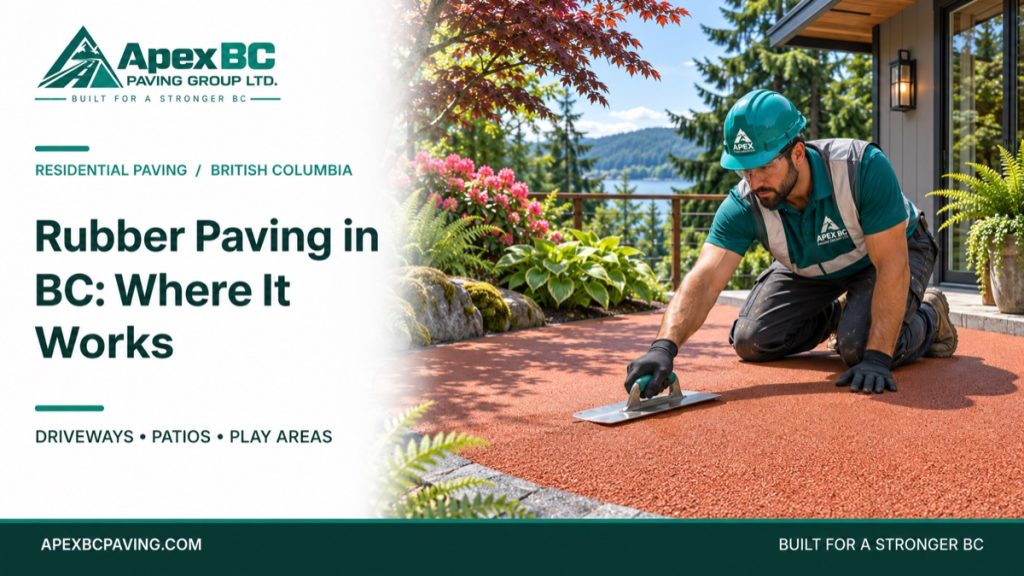
Rubber paving is a poured surface made from recycled rubber granules and a flexible binder, spread over a prepared base. It cures into one seamless layer, so there are no joints and no individual pavers to shift. People choose it for comfort and grip, which is why it turns up on pool decks, patios, pathways and play areas. However, it is not the right answer for every surface, and that part rarely makes the sales pitch.
Here is a plain look at where this surface performs in British Columbia, how it goes down, and where it falls short.
What rubber paving is, in plain terms
Rubber paving starts with recycled rubber granules, usually from tires, mixed on site with a binder. Crews trowel that mix over the prepared base and let it cure. Because the rubber stays slightly flexible, it handles small ground movements better than a rigid slab does. It also stays quieter and softer underfoot than concrete or asphalt.
Thickness changes with the job. A patio overlay is thin and tight, for example, while a play area needs a deeper, more cushioned build. Colour comes from the granules and from pigments blended into the mix, so you pick the look before work starts. Texture ranges from fine and smooth to coarse and heavily grippy.
Where rubber paving works well
Rubber paving earns its keep where comfort, grip and quiet matter more than raw hardness. Think about the spots where people walk barefoot, children fall over, or an old slab looks tired but is still structurally sound.
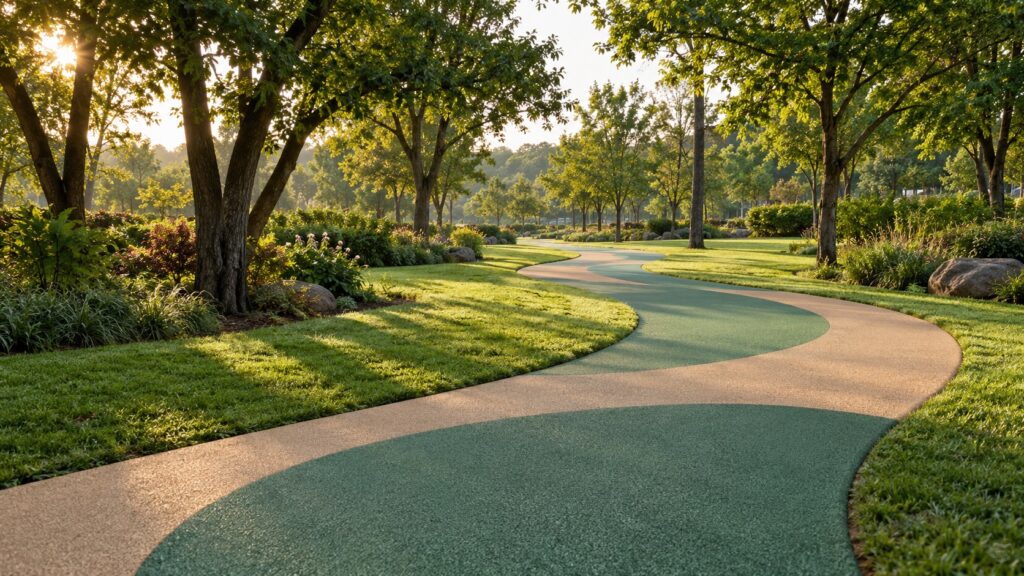
- Pool decks and hot tub surrounds — softer underfoot, and less slick than a smooth slab when wet.
- Playgrounds and play areas — a cushioned surface designed around the fall height of the equipment.
- Patios and walkways — a seamless overlay covers a tired slab without full removal.
- Steps and sloped paths — texture gives better footing in rain.
- Light residential driveways — workable as an overlay where the base below is sound.
- Dog runs and garden paths — easy on paws and knees.
Play surfacing is its own category, because impact attenuation and accessibility are part of the design. CSA Group publishes the Canadian standards used for children’s play spaces, so ask how a proposed build measures up before you commit. You can also look at the poured rubber surfacing options for play and recreation areas.
Drainage and comfort in a wet climate
Coastal BC gets a lot of rain, so drainage drives most surfacing decisions here. Poured rubber can be built as a permeable system that lets water pass through into the base below. That helps with puddling on flat patios and pool decks, because the water drains down instead of sitting on top.
Permeability has limits, however. Water still has to go somewhere once it passes through, so site grading and the base below have to handle it. Clay and silty soils hold water in many BC neighbourhoods, and freeze-thaw cycles in the Interior and on hillsides punish any surface sitting on saturated ground. First sort out the drainage, then choose the finish.
How poured rubber goes down over a prepared base
Preparation decides how long the finished surface lasts. A typical sequence looks like this:
- First, the existing concrete or asphalt is checked for cracks, movement, hollow spots and drainage problems.
- Repairs come next, including crack filling, patching and grinding down high spots.
- Where there is no base at all, one gets built: compacted gravel, then concrete or asphalt. The Cement Association of Canada is a useful starting point if you want to understand concrete bases.
- The surface is cleaned and primed so the binder bonds properly.
- The rubber and binder are mixed and troweled out in one or two layers to the planned depth.
- Finally, the surface cures and stays closed to traffic for a period set by the product and the weather.
Weather sets the schedule. Because the binder needs dry, mild conditions, installations get pushed back during heavy rain or a cold snap. So most poured rubber work in BC happens in the drier, warmer stretch of the year. Permit and bylaw requirements vary as well, so check with your city before changing a driveway or adding a large hard surface.
Where rubber paving does not belong
Rubber paving is an overlay system first, so it inherits whatever sits underneath. Covering a heaving, crumbling or badly draining slab only hides the problem for a while. Here are the honest limits:
- Heavy vehicle traffic. Delivery trucks, parkades, commercial yards and constantly turning wheels scuff and tear a rubber surface.
- Failing bases. If the slab below keeps moving, the overlay will crack or lift along with it.
- De-icing salt and metal tools. Salt, ice choppers and steel plow blades all shorten the life of the surface.
- Strong sun exposure. Colours soften and lighten over the years, so a south-facing deck will not look brand new forever.
- Visible repairs. A patch can be blended in, but the repaired area may never match perfectly.
- Standing water. A permeable top layer cannot fix a site that drains the wrong way.
None of this makes poured rubber a bad product. It simply has jobs it does well and jobs it does not. For a driveway with regular truck deliveries, or a parking area with daily traffic, asphalt or concrete will serve you better.
Keeping a poured rubber surface looking good
Upkeep is light but not zero. Rinse the surface, blow off leaves and needles, and treat stains with a mild cleaner rather than harsh solvents. Also expect a re-coat of binder at some point, because the top layer takes the wear and the sun.
In winter, use a plastic shovel instead of a metal one, and reach for grit or sand rather than de-icing salt. Pressure washing is possible; however, keep the pressure moderate and the wand moving so the top does not get chewed up.
Talk to Apex BC Paving about your project
Apex BC Paving Group works in concrete, asphalt and poured rubber across the Lower Mainland, the Fraser Valley and beyond. So tell us what the space is for, what is there now, and how water moves across it. If rubber paving fits the site, we will explain how it would be built. If a concrete or asphalt surface is the smarter choice, we will say that instead. When you are ready, request a free quote and describe the space you have in mind.